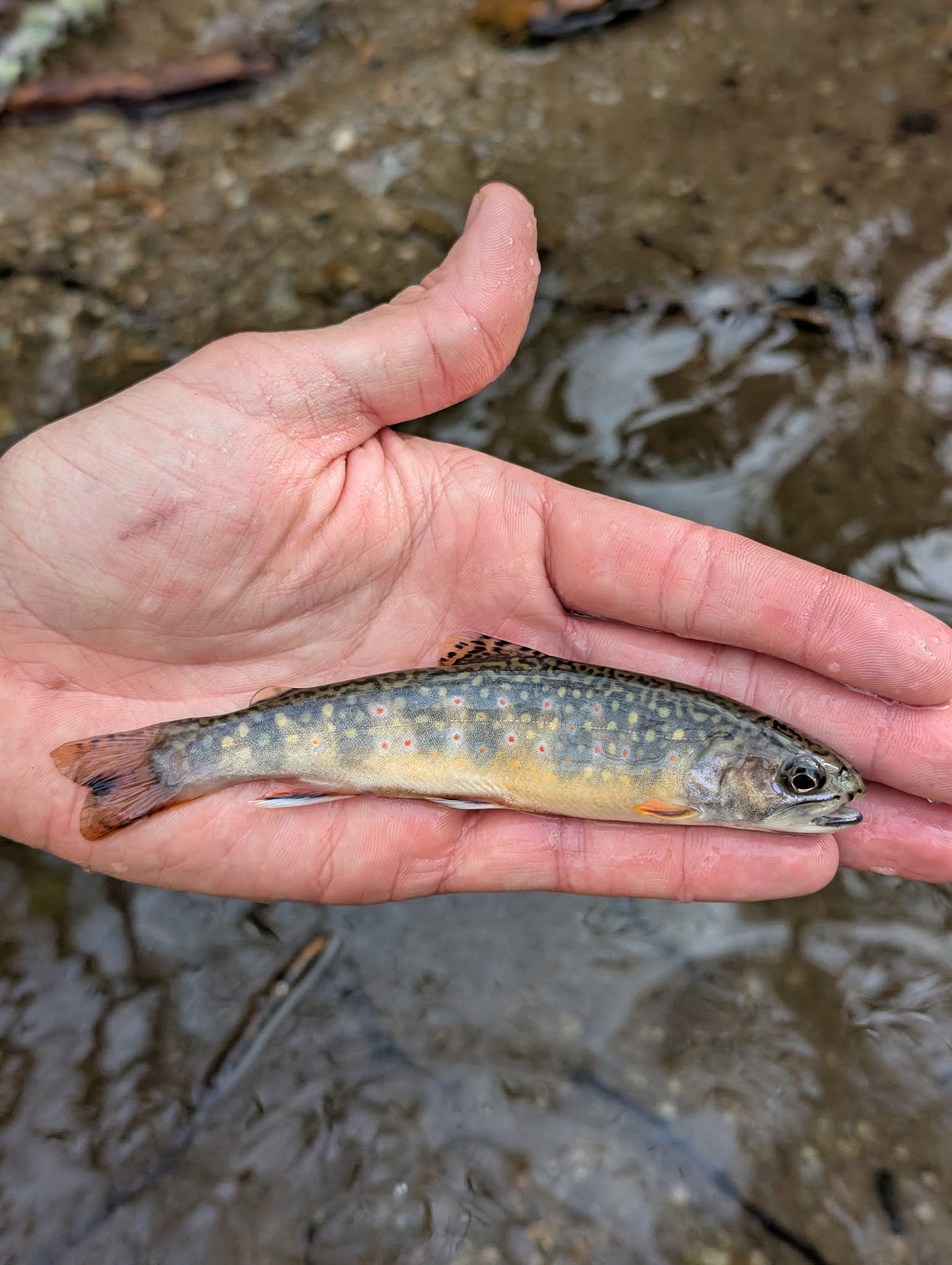
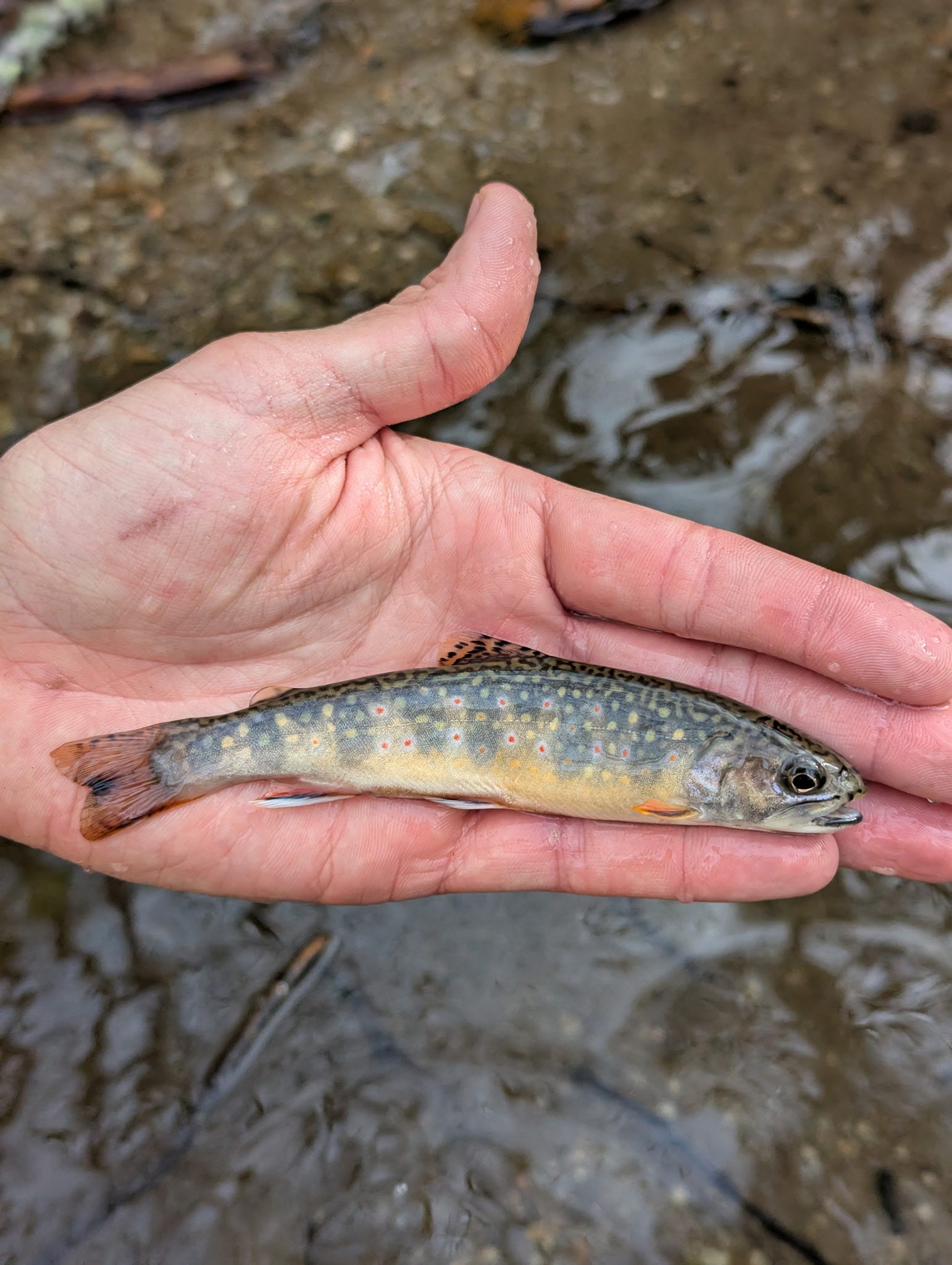
My buddy Tyler stood at the edge of a holler in western North Carolina this weekend and told me something I’ve been stewing on this fine Sunday afternoon in the Sandhills.
He said it’s his mission to make sure his son and his grandson can catch wild brook trout out of the same streams he used to. That they can feel the cold water, pull a native brookie out, and experience the same wonder he did in his childhood up near Traphill.
It used to be that way then, so why not in the future?
The Southern Appalachian brook trout is the only trout native to western North Carolina. Before the logging boom of the 1890s, these streams ran thick with them. Then the timber industry came through, stripped the mountains bare, warmed the water, filled the spawning beds with silt. The fish didn’t stand a chance. Since 1900, the brook trout’s native range in these mountains has declined by 80 percent. They’ve been pushed into the coldest headwater streams, the ones too small and high to reach without a serious hike.
And that’s just one fish in one state.
The northern bobwhite quail, that bird your grandfather probably hunted, the one whose call used to define a Southern morning, is down 85 percent across the United States over the last 50 years. Industrial agriculture ate its habitat. The hedgerows went. The fencerows went. The brushy edges where coveys hid and nested got swallowed by monoculture fields too neat and too large to support anything wild.
The bison are another example. Tens of millions of animals. Herds that stretched 20 miles in every direction across the Great Plains of America. Gone to fewer than a thousand by 1890. Market hunters, a government policy of deliberate extermination, and no one to defend them
The passenger pigeon was once possibly the most abundant bird on earth, making up an estimated 25 to 40 percent of all bird life in North America. Flocks that darkened the sky for days. Extinct. The last one, a female named Martha, died in the Cincinnati Zoo on September 1, 1914.
This is what happens when a generation loses its connection to wild things and wild places. Not a sudden catastrophe. A slow erasure. Species by species, stream by stream, acre by acre. Nobody notices until it’s already gone.
I thought about all of this standing there with Tyler, and I thought about the first time I took my daughter Surrey turkey hunting. She was small. We sat still in the timber and when the first gobble rolled through the trees she froze, completely still, eyes wide. That wonder on her face wasn’t something that could be manufactured. It happened because the woods were real and she was in them.
That’s the whole mechanism of conservation. Not policy. Not organizations. That moment. The one where a kid feels something wild and understands without being told that it matters.
The kids who’ll vote on these lands in twenty years are growing up right now. Most of them have no reason to care. They’re lit up by screens, chasing content, entertained by everything except the world outside their window. Not because they’re wrong for it. Because nobody took them out there and gave them a reason.
That’s on us.
Because right now, while you’re reading this, there are people in positions of power who see what Tyler is trying to protect and see a spreadsheet. Senator Mike Lee spent the better part of last year pushing legislation to mandate the sale of up to three million acres of public land across eleven western states. He dressed it up as housing policy. The Senate parliamentarian knocked it back on procedural grounds, but he’s made clear he’s not done. The Trump administration opened Alaska’s Arctic National Wildlife Refuge, 19 million acres, the largest protected wilderness in the country, home to caribou, polar bears, and 270 species, to oil and gas leasing in October 2025. Decades of protection, reversed by executive order.
These places don’t come back. The brook trout streams are proof of that. The quail fields are proof of that.
You’re either giving your kids a reason to care, or you’re not.
Take them out there. Let something wild get its hooks in them early. Because the people who want to sell it off are counting on nobody caring enough to stop them.
Don’t give them that.
FIELD TIP
Before you make a single cast to a pool, stop and read it.
Figure out where the fish are likely holding and plan the fewest casts possible to cover those spots. One cast to each lie. Native brookies spook fast and they don’t come back. The angler who thinks before he casts catches more fish than the one who covers the water with false hope.
Work upstream, crouch low, keep your shadow off the water. Short 2 or 3wt fiberglass rod and a bushy dry fly like an Elk Hair Caddis with maybe a nymph dropper in cooler temps. These fish aren’t selective, food is scarce up there and they’ll eat almost anything presented cleanly.
The streams worth fishing require a hike. In western North Carolina that often means heading up above 2,500 feet. Anything accessible from the road has been picked over.
One cast. One shot. Move on.
MINDSET: Shut Up and Do It
There’s research showing that when you announce a goal, your brain registers a social reward before you’ve done anything. The acknowledgment feels like progress. It isn’t. It’s a shortcut that quietly drains the motivation you needed to do the actual work.
You’ve seen this. The guy who tells everyone he’s going to get in shape, write the book, start the business. The announcement is easy. It feels good. And more often than not, the thing never happens.
The model is simple: keep your mouth shut until the work is done.
Don’t post about what you’re going to do. Don’t tell your buddies about the plan. Don’t rehearse the version of yourself who already finished it. Just go do the thing in the dark, without an audience, without validation, without the cheap hit of someone saying that sounds great.
The work itself will tell you if it was worth doing.
When Tyler said he’s going to get brook trout back in those streams for his grandson, he didn’t say it to get credit for the idea. He said it because he’s already doing it. That’s the difference.
Protect your goals like you protect a fire in the wind. Keep them close. Keep them covered. Feed them with action, not words. Then enjoy the warmth after it’s roaring.
"In wildness is the preservation of the world."
-Henry David Thoreau
What world are you leaving behind in your actions today?
Share this article:
AN
Austin Nicholas
Founder of Wilderness Father
The Sunday Dispatch
Free field notes. Every Sunday.
Real stories from the woods, the water, and the work of raising kids who can think, adapt, and provide.